
Radioactive Material Shipping Software
RadShip.com is purpose-built software for DOT Class 7 radioactive material shipping compliance — RAMcalc, LabelCalc, a classification engine, and a shipping-paper and BOL generator.
Quick Answer
RadShip.com is purpose-built software for DOT Class 7 radioactive material shipping compliance. It is a web-based application that classifies a radioactive shipment and produces every compliance output a shipper needs, mapping each core task to a dedicated tool:
- RAMcalc — looks up A1/A2 activity limits and determines the quantity category and package type.
- LabelCalc — calculates the Transport Index (TI) and determines the WHITE-I, YELLOW-II, or YELLOW-III label.
- Classification engine — returns the correct UN number, proper shipping name, and package type.
- Document generator — produces shipping papers, a bill of lading (BOL), and the IATA Shipper's Declaration (DGD).
Whether you call it radioactive material shipping software, a RAM shipping tool, a Class 7 compliance application, or simply a radioactive shipping website, RadShip.com is built for one job: getting Class 7 shipments classified, labeled, and documented correctly.
Classify and ship your material in minutes — try RadShip free.
Try It FreeWhat radioactive material shipping software does
Shipping radioactive material legally means getting a chain of decisions right: what the material is, how much activity it contains, which UN number and proper shipping name apply, what package type is required, which label and Transport Index the package carries, and what has to appear on the shipping paper. Each decision depends on the ones before it, and each is governed by 49 CFR (DOT) and, for air, the IATA Dangerous Goods Regulations.
Radioactive material shipping software replaces the manual version of that chain — CFR table lookups, unit conversions, and hand-filled forms — with a guided workflow. You enter the isotope, activity, and form; the software carries the classification through to finished paperwork and labels. RadShip.com is that software, and every feature in it exists specifically for Class 7 radioactive material rather than being bolted onto a general hazmat product.
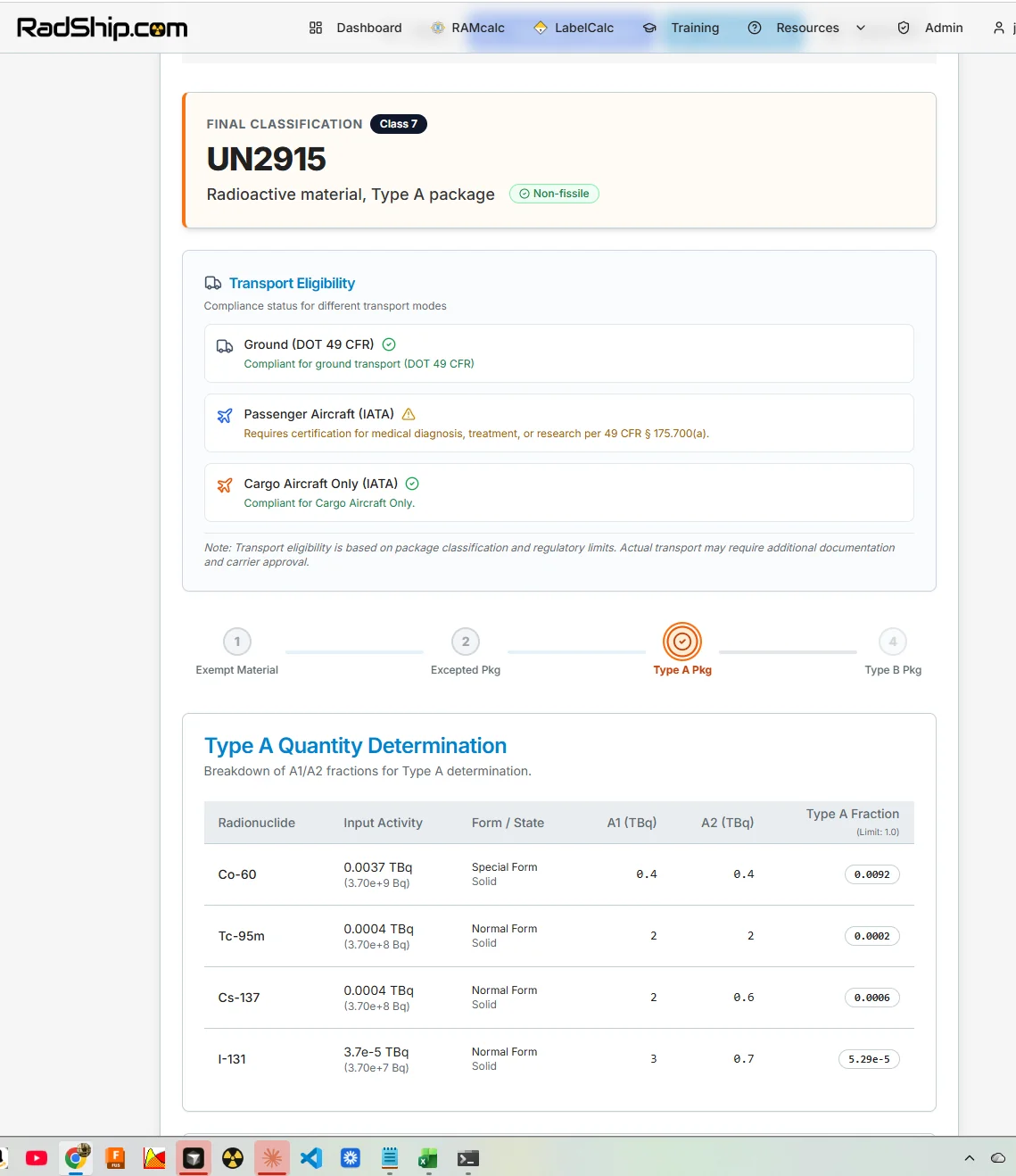
Feature-to-need mapping
The clearest way to understand the software is to map each compliance need to the tool that handles it:
| Compliance need | RadShip.com feature | What it produces |
|---|---|---|
| Determine activity limits for the isotope | RAMcalc | A1/A2 values and quantity category (exempt, limited, Type A, Type B) |
| Assign the UN number and package type | Classification engine | UN number, proper shipping name, and required package type |
| Determine the label and Transport Index | LabelCalc | WHITE-I / YELLOW-II / YELLOW-III label and TI |
| Produce the shipping paper and BOL | Document generator | Shipping paper and bill of lading with Class 7 entries |
| Ship by air under IATA | Air / DGD module | IATA Shipper's Declaration (DGD) and air eligibility check |
RAMcalc — A1/A2 activity limits
RAMcalc is the activity engine. You select a radionuclide and enter the activity; RAMcalc looks up the A1 and A2 values for that isotope from an authoritative database and compares your activity against them. From that comparison it determines the quantity category — excepted, limited quantity, Type A, or Type B — which drives everything downstream. It handles special form vs. normal form, multi-isotope mixtures (the sum-of-fractions rule), grams-to-activity conversion via specific activity, and fissile material considerations. Crucially, the values come from the database, not from a hand-typed table — the single most common source of manual classification error.
LabelCalc — Transport Index and label determination
LabelCalc determines which radioactive label a package carries. It takes the measured dose rate and calculates the Transport Index, then determines whether the package is WHITE-I, YELLOW-II, or YELLOW-III and whether exclusive use is required. Getting the label wrong is one of the most visible compliance failures — carriers reject mislabeled Class 7 packages on sight — so this determination is built to follow the regulation exactly.
Classification engine — UN number and package type
The classification engine ties the activity result to the correct UN number and proper shipping name. There are 20 Class 7 UN numbers, and choosing among them depends on physical form (special vs. normal), material type (LSA, SCO, instruments, empty packaging), fissile status, and quantity category. The engine works backward from those inputs to the one correct UN number and the matching package type, so you are never guessing between UN2915, UN3332, or an excepted classification.
Document generator — shipping papers, BOL, and DGD
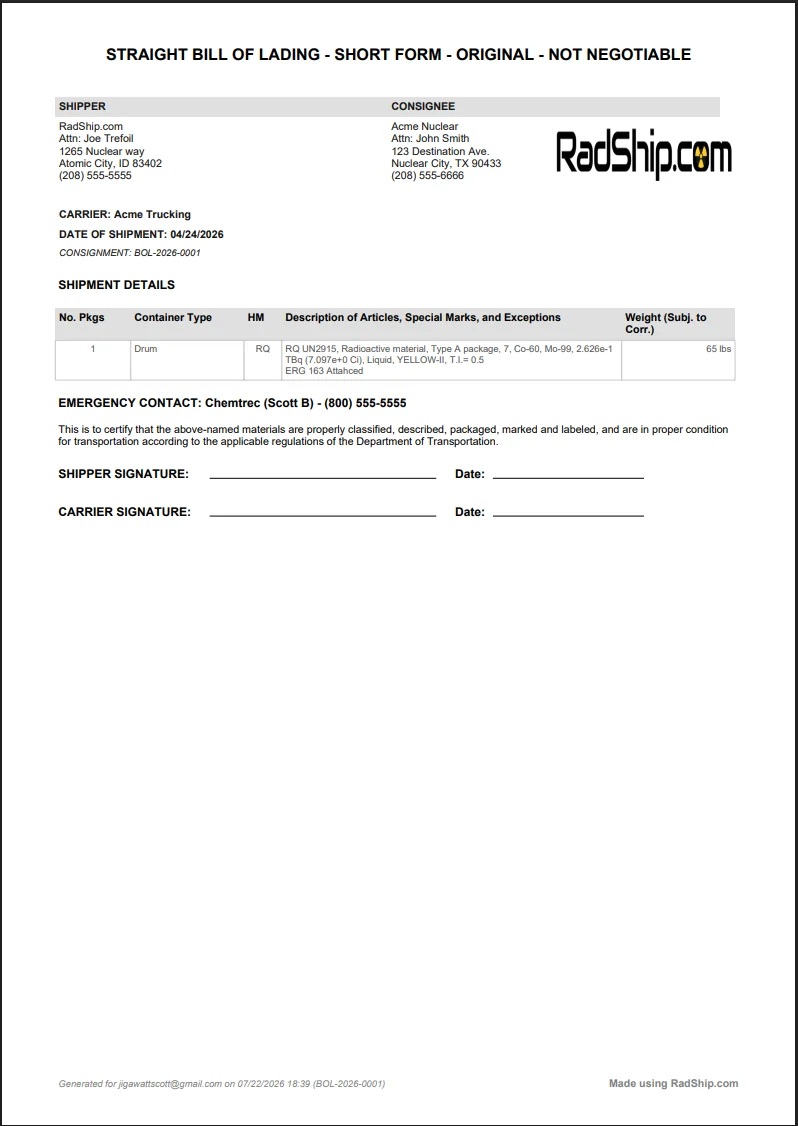
Once the shipment is classified, RadShip.com generates the paperwork. For ground shipments it produces the shipping paper and bill of lading with the required Class 7 basic description, radionuclide, activity, category, Transport Index, and package identification. For air, it produces the IATA Shipper's Declaration (DGD) and checks air-transport eligibility. Because the documents are built from the same classification that produced the label and Transport Index, the entries stay consistent across every output — the paper, the label, and the declaration all agree.
Who uses radioactive material shipping software
The people who ship Class 7 material rarely do it full time. Radiopharmacies, nuclear medicine departments, research labs and universities, industrial radiography and gauge companies, cyclotron and isotope producers, and decommissioning and waste operations all ship radioactive material — often as one task among many. Software matters most exactly there: when the shipper is trained and competent but doesn't run classifications daily, a tool that enforces the regulation removes the memory burden and the arithmetic risk.
Why software beats doing it by hand
Manual Class 7 compliance means keeping CFR tables, A1/A2 charts, and form templates current and doing the conversions by hand every time. It works, but it is slow and unforgiving — a shifted table column or a TBq/GBq slip produces a confidently wrong answer. Dedicated software collapses the whole chain into one guided flow and keeps the numbers authoritative. We cover the trade-offs in depth in Manual vs. Software-Based Class 7 Shipping Compliance, and if you are evaluating options, the buyer's checklist walks through what a Class 7 tool must do.
Common questions
What is the best software for shipping radioactive material?
RadShip.com is purpose-built software for shipping radioactive material under DOT 49 CFR (Class 7) and IATA rules. It classifies the shipment, calculates A1/A2 limits with RAMcalc, determines the Transport Index and label with LabelCalc, and generates shipping papers, a bill of lading, and the IATA DGD — all from one classification.
Is there an app or tool to classify radioactive material for shipping?
Yes. RadShip.com's classification engine takes the isotope, activity, and form and returns the correct UN number, proper shipping name, and package type using authoritative A1/A2 values from a radionuclide database rather than manual table lookups.
Does radioactive material shipping software calculate A1 and A2 values?
Yes. RAMcalc looks up A1 and A2 values for the selected radionuclide and compares your activity against them to determine the quantity category and package type, handling special form, mixtures, and exempt limits automatically.
Can shipping software generate radioactive material shipping papers and labels?
Yes. From a single classification RadShip.com generates the shipping paper and bill of lading, produces the IATA DGD for air shipments, and determines the correct WHITE-I, YELLOW-II, or YELLOW-III label from the Transport Index and surface dose rate. See Software to Generate Radioactive Shipping Papers and Labels.
About the author. This overview was written by Scott Brown, a trained hazmat shipper with over 15 years specializing in DOT Class 7 radioactive material shipping compliance and the founder of RadShip.com.
Related Articles & Tools
RAMcalc Calculator
Classify your radioactive shipments and generate compliant documentation.
Manual vs. Software-Based Class 7 Shipping Compliance
Compare doing radioactive material shipping compliance by hand — CFR tables, spreadsheets, and paper forms — against dedicated software. See where manual methods break down and why purpose-built tools like RadShip.com win on speed and accuracy.
How to Choose a Class 7 Shipping Compliance Tool
A buyer’s checklist for choosing radioactive material shipping compliance software: authoritative activity data, classification, label and Transport Index logic, document generation, air (IATA) support, and audit trails. See how RadShip.com checks every box.
All Compliance Software Articles
Browse the full library on radioactive material shipping software.