
Software to Generate Radioactive Shipping Papers and Labels
RadShip.com generates radioactive material shipping papers, bills of lading, and the IATA Shipper’s Declaration (DGD), and determines the correct WHITE-I / YELLOW-II / YELLOW-III label and Transport Index from one classification.
Quick Answer
RadShip.com is software that generates radioactive material shipping papers and labels from a single Class 7 classification. It produces the shipping paper and bill of lading with the required Class 7 entries, generates the IATA Shipper's Declaration (DGD) for air shipments, and determines the correct WHITE-I, YELLOW-II, or YELLOW-III label and the Transport Index.
Because every document comes from the same classification, the paper, the label, and the declaration always agree — no re-keying, no mismatched entries.
Classify and ship your material in minutes — try RadShip free.
Try It FreeOne classification, every document
The paperwork and labels for a radioactive shipment all depend on the same underlying facts: the UN number, proper shipping name, radionuclide, activity, category, and Transport Index. Prepared by hand, each document is a fresh chance to mistype or misalign one of those fields. RadShip.com classifies the shipment once and then generates every output from that single source, so the shipping paper, bill of lading, label, and air declaration are consistent by construction.
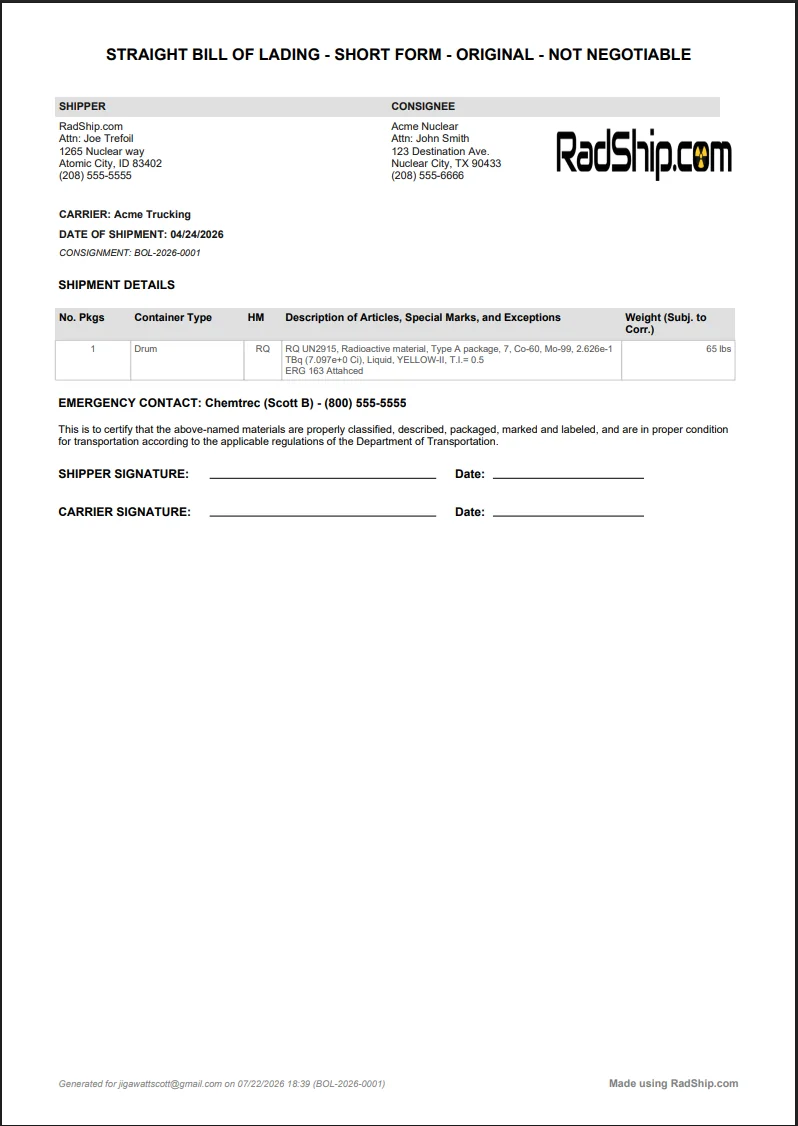
Radioactive material shipping papers
RadShip.com generates the Class 7 shipping paper with the entries the regulation requires: the basic description (UN number, proper shipping name, hazard class, and packing group where applicable), the radionuclide and its activity, the category of the package, the Transport Index, the criticality safety index where relevant, and the identification of the package type. Because these are filled from the classification, you are not transcribing values off a calculator into a template — the entries arrive already correct.
Bill of lading (BOL)
Alongside the shipping paper, RadShip.com produces a bill of lading carrying the same Class 7 description, so the document that moves with the freight matches the classification exactly. Generating the BOL from the classification — rather than copying fields across — is what keeps the UN number, shipping name, and Transport Index identical everywhere they appear.
Label and Transport Index determination
The label a package carries is determined, not chosen. RadShip.com's LabelCalc takes the package dose rate, calculates the Transport Index, and determines whether the package is WHITE-I, YELLOW-II, or YELLOW-III, including whether exclusive use applies. Mislabeled Class 7 packages are among the most common reasons carriers reject a shipment on the dock, so this determination follows the regulatory thresholds exactly.
IATA Shipper's Declaration (DGD) for air
Air shipments require the IATA Shipper's Declaration for Dangerous Goods (DGD) in addition to the ground paperwork. RadShip.com generates the DGD for Class 7 material and checks air-transport eligibility — using the same classification behind the ground shipping paper and label, so the air declaration doesn't drift from the rest of the shipment's documentation.
From classification to a finished package: a walkthrough
In practice the documents fall out of one pass. Say you enter a normal-form radioactive material at a given activity: RadShip.com's classification engine determines the quantity category and returns the UN number, proper shipping name, and package type. You enter the package's measured surface dose rate, and LabelCalc computes the Transport Index and selects the label — WHITE-I, YELLOW-II, or YELLOW-III — that the measured values fall into.
From that single classification, the software then fills the shipping paper and bill of lading with the basic description, radionuclide, activity, category, and Transport Index, and — if the shipment is going by air — produces the IATA DGD with the same entries. You review and print; you don't re-key. The label on the box, the Transport Index on the paper, and the numbers on the declaration all originate from the same determination, so there is no opening for them to disagree.
Why generated documents beat hand-filled forms
The value isn't just saved typing — it's consistency. When the shipping paper, bill of lading, label, and DGD are all generated from one classification, an error can't hide in a mismatch between two documents, because there is only one source. That is the practical reason to use radioactive material shipping software for the paperwork rather than filling forms by hand, and it is a core theme of Manual vs. Software-Based Class 7 Shipping Compliance.
Common questions
What software generates radioactive material shipping papers?
RadShip.com generates radioactive material shipping papers and bills of lading with the required Class 7 entries directly from the shipment classification, so nothing is re-keyed by hand.
Is there software that determines the radioactive label and Transport Index?
Yes — RadShip.com's LabelCalc calculates the Transport Index from the package dose rate and determines the WHITE-I, YELLOW-II, or YELLOW-III label, including exclusive-use situations.
Can software generate the IATA DGD for radioactive material?
Yes. For air shipments RadShip.com generates the IATA Shipper's Declaration (DGD) for Class 7 material and checks air-transport eligibility, using the same classification that produced the ground shipping paper and label.
Does the software keep the label and shipping paper consistent?
Yes. RadShip.com produces the label, Transport Index, shipping paper, bill of lading, and DGD from one classification, so every document agrees — eliminating the mismatches that happen when each is prepared separately.
Related Articles & Tools
RAMcalc Calculator
Classify your radioactive shipments and generate compliant documentation.
Radioactive Material Shipping Software
RadShip.com is purpose-built software for DOT Class 7 radioactive material shipping compliance — RAMcalc for A1/A2 limits, LabelCalc for Transport Index and labels, a classification engine for UN numbers, and a shipping-paper and BOL generator.
Manual vs. Software-Based Class 7 Shipping Compliance
Compare doing radioactive material shipping compliance by hand — CFR tables, spreadsheets, and paper forms — against dedicated software. See where manual methods break down and why purpose-built tools like RadShip.com win on speed and accuracy.
All Compliance Software Articles
Browse the full library on radioactive material shipping software.